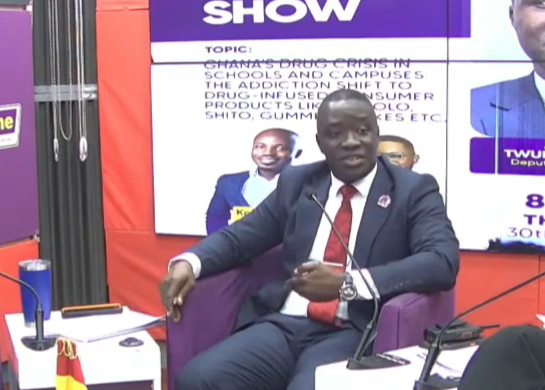
The Narcotics Control Commission (NACOC) is proposing mandatory drug testing for students seeking admission to universities and graduates preparing for national service as part of efforts to tackle drug abuse among young people.
Deputy Director-General of NACOC, Alexander Twum-Barimah, said the proposal is intended to help identify students who use drugs at an early stage and discourage substance abuse throughout their academic and professional journey.
Speaking on Joy FM’s Super Morning Show on Thursday, July 30, during a discussion on the growing incidence of drug abuse in schools and tertiary institutions, Mr Twum-Barimah suggested that drug screening be incorporated into the routine medical examination required for university admission.
“My request is this: various universities, private and public, within the country should agree with us that we should be testing,” he said.
“You know, when we are admitted, we do the medical. So, as part of that entry requirement, part of that medical examination should be your drug test.”
According to him, screening students at the point of admission would enable institutions to identify those who may already be abusing drugs and provide the necessary support and intervention.
“So that now we can know those who are coming in on high levels of drugs, or those who are not coming in on drugs,” he explained.
Mr Twum-Barimah also expressed concern over reports that some students use drugs to enhance their academic performance during examinations.
“Sometimes, too, people say that around exam time, people take drugs to study and all that. So we should have this as part and parcel of the structure,” he said.
He further proposed that drug testing should become a mandatory requirement before graduates begin their national service.
“Even when you are done, and you’re about to start your national service, I’m urging that it should be part and parcel of the requirement that you should be doing drug tests before,” he said.
Mr Twum-Barimah argued that the policy would serve as a deterrent, as students would know they would have to undergo screening before progressing to national service and eventually into employment.
“If I know that today I’m in Level 100, by the time I finish Level 400 and go to do my national service, I’m going to do a drug test. If I don’t do the drug test, Multimedia will not accept me to come and do my national service. Will you be on drugs? The answer is no,” he said.
He added that similar screening could be extended to recruitment into security agencies and other public institutions.
“Even when you are done with your national service, and you want to join the military, police, or any other institution, you are also going to be tested on drugs. Will you still be on drugs? The answer is no,” he added.
Responding to a question on whether drug test results should be shared with prospective employers, Mr Twum-Barimah said NACOC supports making the information available to organisations involved in the recruitment process.
“We let you know that these individuals that you brought to us or that we tested… this one is testing positive for this drug, this one is negative for this drug. Then you make your own decision,” he stated.
READ:
GTEC orders tertiary leaders to quit party executive roles or leave…
He raised me and made me who I am today –…
