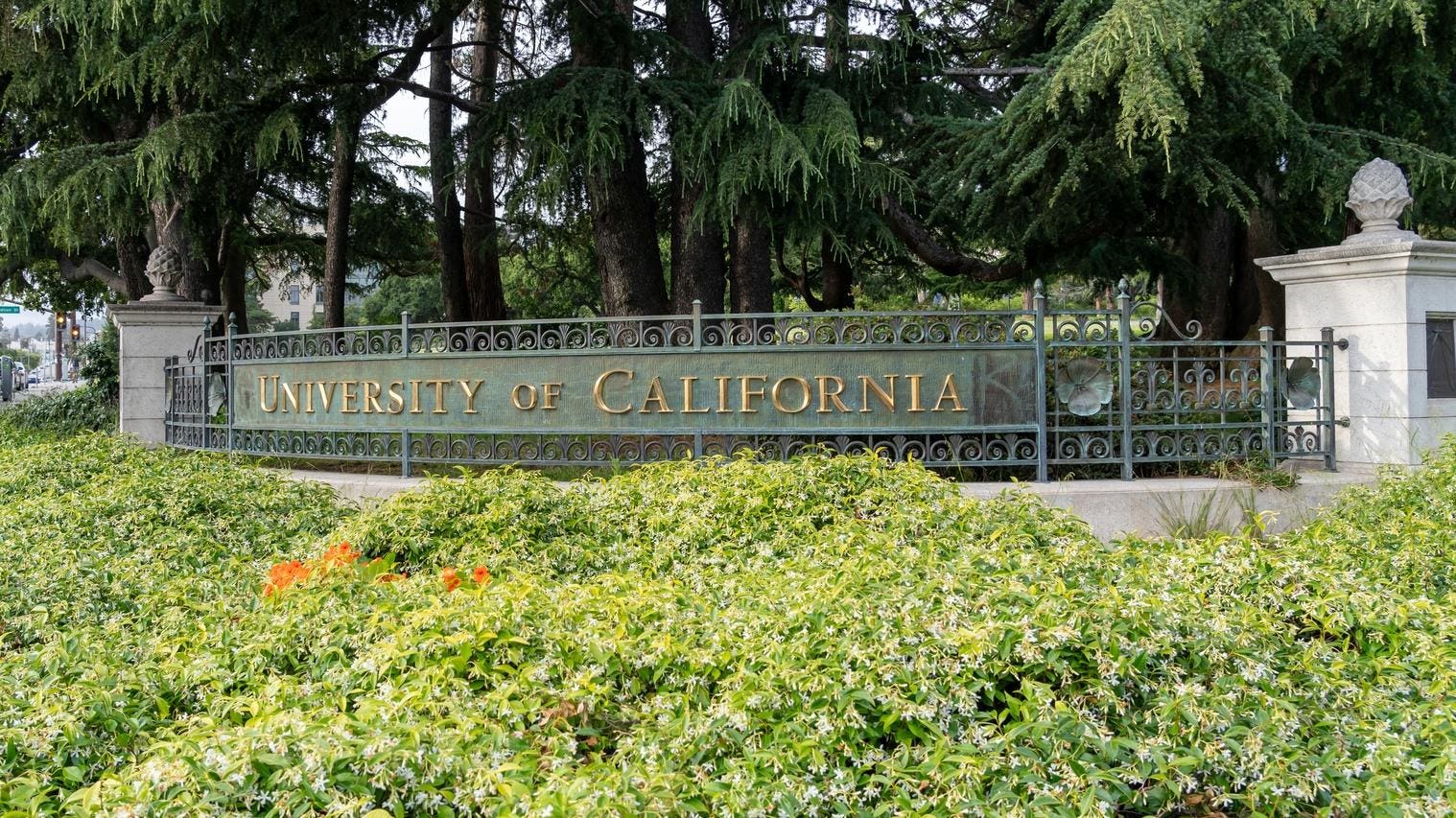

University of California sign outside the UC Berkeley campus, California, USA, June 5, 2023. The University of California, Berkeley is a public land-grant research university.
getty
This weekend, the University of California system released the results of the last application cycle, continuing its pattern of providing admissions data after the cycle concludes. Though the UC’s process of holistic reviews has come under fire for its lack of transparency, students and families can glean subtle indications of a school’s admissions priorities and practices not only from the data itself, but by what the institution chooses to highlight from its broader dataset.
While these numbers are always instructive, this year’s data offers valuable insights into how a major public university system is navigating an increasingly fraught moment for higher education, amidst state funding mandates, federal political pressure, shifting international enrollment patterns, and an ongoing national debate over who public universities are supposed to serve. In other words, these results say as much about the current state of American public higher education as they do about UC specifically.
For students anticipating applying to a UC school in the coming months, these are the most important takeaways from last year’s admissions cycle—and how they should impact applicants’ strategies:
1. Out-of-State Admission is Only Growing More Competitive
The UC system admitted a record 102,031 California resident first-year students for the 2026-27 cycle, up from the prior year, with the systemwide admission rate for in-state applicants ticking up to 78%. At UCLA alone, the first-year admission rate climbed to about 10.8%, a noticeable jump from 9.4% the year before. Meanwhile, Berkeley, which reclaimed its status as the most selective campus in the UC system this cycle, reported a 10.5% admissions rate, also up from 9.4% the previous year, edging out UCLA for the tightest odds systemwide.
These numbers are significant in context. Over the last few years, the UC system has been under immense pressure to reaffirm its commitment to educating the residents of the state. Public universities across the country have faced escalating scrutiny from the Trump administration over whether they are adequately serving in-state and domestic students. The increase in in-state acceptances reflects the UC and California State University systems’ funding compact with Governor Gavin Newsom, which requires the university to grow California undergraduate enrollment by at least 1% annually for five years in exchange for increased state funding. UC’s own 2030 Capacity Plan, aiming to add 17,000 California resident undergraduates, is also motivating this growth.
None of this means out-of-state applicants should abandon their UC ambitions. But they should understand they’re competing for a comparatively smaller and more selective slice of each incoming class, even as overall admit numbers climb—and they should build their strategy accordingly. This means, among other things, exceeding the 3.4 GPA requirement for out-of-state applicants, demonstrating rigor and variety in one’s transcript, and carefully crafting their responses to the “Personal Insight Questions” (PIQs) to support a cohesive narrative across their other application materials.
2. Testing Policies May Be Impacting the Admissions Pool
This year’s cycle also unfolded against the backdrop of an unresolved debate over UC’s test-blind admissions policy. The 2021 legal settlement that locked in test-blind status expired in spring 2025, opening the door to the first reconsideration of the policy since the pandemic. This year, more than 1,400 UC faculty members—including several mathematics department chairs—petitioned the university to reinstate standardized testing, citing steep declines in incoming students’ math preparedness. The faculty admissions board took up a formal review, and this past July, the Board of Regents briefly moved to expedite a decision.
Ultimately, that expedited timeline didn’t hold. In late July, the Regents opted instead to delay any decision on reinstating the SAT or ACT until June 2027, which means the current test-blind policy remains in place for the upcoming cycle. Despite the delay, applicants should recognize that the fate of standardized testing is not decided at UC schools. The underlying pressure from faculty concerned about academic preparedness, and from a broader national environment skeptical of test-optional and test-blind admissions continues to grow, and a policy reversal beyond 2027 remains an imminent possibility. Students applying after this cycle should begin preparing early for standardized testing to ensure that their scores stand out if a testing requirement is reinstated.
Finally, it is worth noting that UC campuses like Berkeley and UCLA remain among the very few top-25-ranked schools in the country that do not consider standardized test scores. That distinction has likely broadened the applicant pool, drawing in students who might otherwise self-select out of a testing-required process, which can make admit rates look more competitive than they may otherwise be. Reinstituting a testing policy may impact the volume of applicants at schools like UCLA, which is currently one of the most applied-to schools in the United States.
3. Amidst Economic Uncertainty, Socioeconomic Mobility Has Become an Important Selling Point
Over the last decade, the UC system has affirmed a sustained commitment to admitting low-income and first-generation students, and this year’s data shows the continuation of those efforts. Forty-three percent of admitted California first-year students—44,335 students—came from households with a weighted income of $85,000 or less. First-generation students made up 41% of California first-year admits, totaling 42,277 students. Community college transfer admissions also hit a record 29,372 students, with more than half identified as low-income and nearly half as first-generation.
Drawing in students from a wide range of socioeconomic backgrounds is, in part, a way for public university systems to diversify their classes without running afoul of California’s ban on race-based affirmative action, which has been in place since 1998. But that’s not the only factor at play.
Reflecting on the admissions cycle, the president of the university system, James Milliken, called the UC system “one of the state’s most powerful engines of social mobility.” The language reflects a broader institutional argument that in a moment of real economic uncertainty for many California families, public universities have a role to play not just in individual student outcomes, but in the state’s overall economic vitality. As economic challenges and the rising costs of higher education continue to impact broad swatches of college applicants, this commitment to economic mobility and professional success is one that many top colleges will likely continue to reinforce.
Last year’s data offers a preview of what applicants in this year’s UC applicant pool can expect. While the opening of applications marks an exciting phase in a student’s admissions journey when hard work turns into the possibility of an acceptance, students should approach this season with strategy, intentionality, and research to maximize their odds of admission.
