
TOKYO — The use of generative artificial intelligence (AI) in exam preparations is becoming increasingly common among students in Japan, with some having mastered the technology well enough to earn admission to Japan’s most selective universities without attending cram schools.
Meanwhile, AI has advanced to the point where it can perform at a level equivalent to the top-ranked student admitted to the University of Tokyo, raising the prospect of fundamentally changing the way entrance examinations are approached.
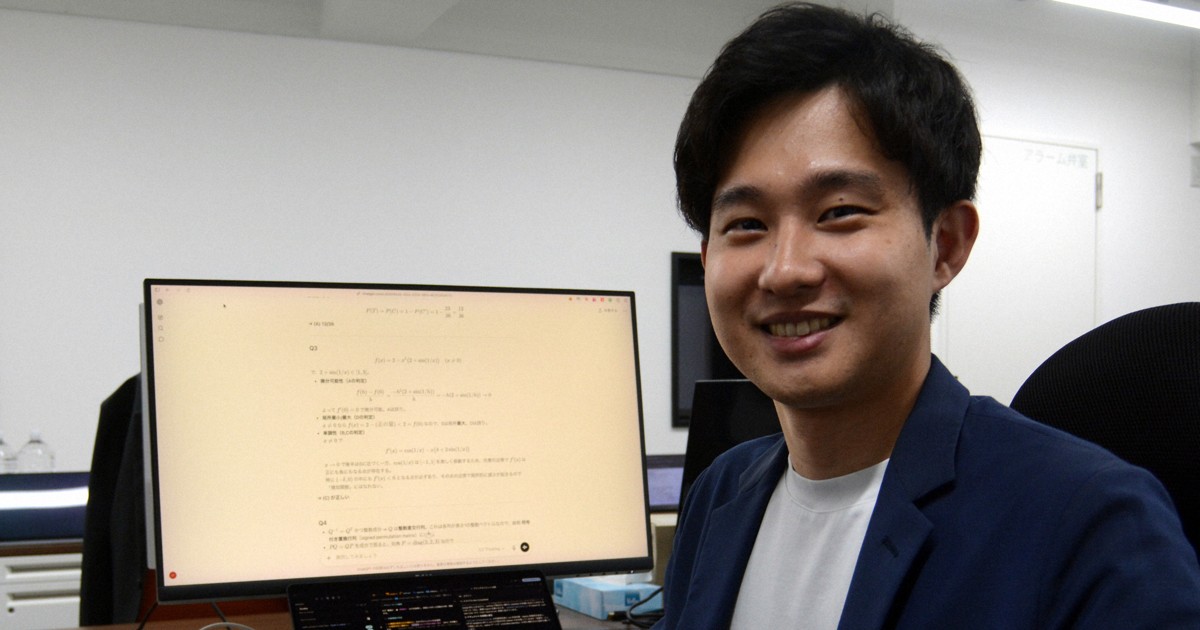
“I realized it was faster to create my own study materials than to rely on existing ones,” Soshiro Yoshida, a 19-year-old student at the University of Tokyo’s College of Arts and Sciences on the Komaba campus, described his experience studying for the entrance exam.
He entered the university’s Humanities and Social Sciences II division in last year’s admissions. Instead of attending a cram school, he followed his own study methods. His main tool was a smartphone installed with a generative AI app.

Yoshida used ChatGPT, affectionately nicknamed “Chappy” by Japanese users, operated by the American artificial intelligence research organization OpenAI. To study English, he photographed past University of Tokyo entrance test questions and textbook pages with his phone, then uploaded them to the AI. Using those materials, he gave prompts such as, “Create a reading comprehension passage of about 700 words,” and had the AI generate practice questions.
For world history, he experimented with having the AI translate his textbooks into English so he could study both subjects at the same time. Some approaches did not always produce the learning results he hoped for, but he explained, “With AI, you can always just try something. I experimented with all kinds of methods, learning through trial and error.”
He also used AI to organize his math notes. Tasks that once took much longer were reduced to nearly one-tenth of the time, allowing him to devote the extra time to studying.
Yoshida said he had always wanted to “avoid relying on cram schools or commercial study guides.” He had dreamed of attending the University of Tokyo since childhood and entered a highly competitive integrated junior and senior high school after passing the middle school entrance exam. Since he already had support from his teachers, he felt that attending cram school and learning from multiple instructors was inefficient.
The turning point came when his high school purchased a bulk subscription to the paid version of ChatGPT, giving students access. At first, he used it casually, asking it to translate textbook passages or organize his world history notes. Eventually, he began wondering whether it could also help with entrance exam preparations and started using it seriously. He even had the AI create his study schedule. While many of his competitors relied heavily on cram schools and prep books, Yoshida commented, “Maybe I got in because I did something different from everyone else.”
Studyplus Trend Kenkyujo, a Tokyo-based organization that engages in educational support services, conducted a survey targeting 3,000 students who took entrance exams for the 2025 academic year. Of the respondents, 88.7% said they had used AI while studying. Many reported using it to review English compositions and essays.

Then in April of this year, the results of an experiment announced jointly by Tokyo-based AI startup LifePrompt Inc. and other firms including major test preparation company Kawaijuku sent shock waves through Japan’s education industry.
In the experiment, generative AI systems were given entrance exam questions for some of Japan’s most competitive universities. According to the results, the AI achieved scores above every human test-taker on exams including those for the Natural Sciences III division of the University of Tokyo’s Faculty of Medicine and Kyoto University’s Faculty of Medicine. In some subjects, including mathematics, the AI earned perfect scores.
The exam papers were simply converted into images, which were then fed into generative AI systems such as ChatGPT. The AI quickly produced complete answers, including detailed solution steps.
When a similar experiment was carried out three years ago using Japan’s nationwide Common Test for University Admissions, the AI only scored slightly above the average student. LifePrompt CEO Satoshi Endo, 27, commented with a wry smile, “Even the AI back then felt impressive, but its capabilities have since improved so dramatically that it doesn’t surprise me anymore.”
On the other hand, Teruya Amino, a senior executive at Kies Co., a Kawaijuku Group company that develops educational materials, who participated in the experiment, remains skeptical about using AI as a “teacher” when studying for entrance exams.

“With today’s technology, AI can certainly solve most problems. But that doesn’t automatically mean it can teach them,” he told the Mainichi Shimbun.
For example, when solving math problems, AI tends to choose the most efficient solution. In doing so, however, it may use advanced concepts that are not taught in Japanese high schools. Amino pointed out, “Studying for entrance exams isn’t simply about getting the right answer. It’s about learning how to apply the knowledge you’ve studied to solve problems. If students trust the AI’s methods, they may find those approaches cannot be used during actual tests.”
Despite those concerns, excessive trust in AI already appears to be spreading among students. Kawaijuku says it has received several inquiries from students who took its practice exams claiming that the school’s official answers must be wrong because they differed from ChatGPT’s output.
“In every such case, the answers of cram schools were correct,” Amino stated. “What worries me is that the students’ only reason for questioning them was because ‘the AI said so.’ If users don’t think critically for themselves, they risk becoming people who are simply led around by AI.”
(Japanese original by Yongho Lee, Editorial Division)
