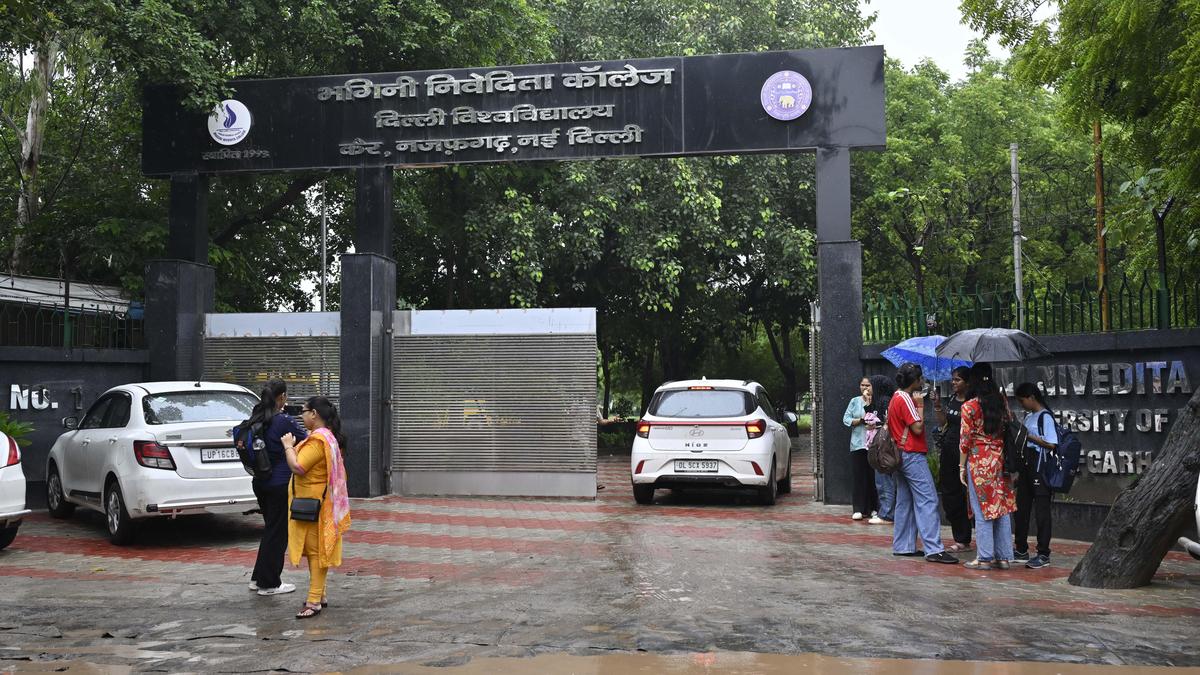
Two women’s colleges of Delhi University (DU) have begun admitting students on the basis of their Class 12 board results after nearly 2,000 seats remained vacant under the university’s centralised admission process through the Common University Entrance Test (CUET).
The separate admission process at Aditi Mahavidyalaya in northwest Delhi’s Bawana and Bhagini Nivedita College (BNC) near Najafgarh, close to the Delhi-Haryana border, has brought into focus the difficulties faced by colleges that were established to serve students from rural and semi-urban areas but now operate within a university-wide admission system.
Aditi Mahavidyalaya and BNC are around 31 km and 59 km, respectively, from DU’s North Campus.
In 2022, DU began admitting students through CUET under its Common Seat Allocation System portal. Since then, the two colleges have reported hundreds of vacant seats each year. Aditi Mahavidyalaya has filled no more than 40% of its seats, with around 1,000 seats vacant this year. BNC has 985 vacant seats, according to its admission prospectus.
Last year, DU conducted a mop-up round based on board examination results to fill vacant seats across the university. While the authorities of the two colleges said they had been seeking a separate admission process since last year, for the first time, the university has allowed the two colleges to conduct admissions separately this year.
“We granted permission for separate admissions because seats were not being filled. This is primarily because the colleges are on the outskirts,” a DU official said.
Admissions are being conducted both online through the colleges’ websites and offline. Both colleges completed their first round of admissions on Friday and will begin the second round next week.
Catering to the neighbourhood
The college continues to draw students from nearby areas. Four recently admitted students met outside the college were from the surrounding neighbourhoods and were looking for a rickshaw to return home, about 15 minutes away. Out of them only one had appeared for CUET.
Neelam Rathi, principal of Aditi Mahavidyalaya, said a centralised system in which students provide their college preferences on a common portal is not suited to an institution intended to serve students in the surrounding rural belt.
“Those who apply for CUET want to be in the campus area and do not want to travel far. Many also prepare for competitive examinations and want to be near coaching hubs,” she said. “We are happy that the university has allowed us to conduct separate admissions. It will motivate girls from nearby areas to pursue higher education.”
Rashi Bharadwaj, 17, a resident of Nangloi, said she had nearly missed out on a DU admission because her CUET performance was not as good as her Class 12 board results.
At BNC, faculty members have been conducting admissions in a separate room and informing parents about nearby public transport routes.
Rashi’s father, Puspendra Kumar, a businessman, said distance had initially been a concern. “I came today to check the metro train and bus routes. Going to any other DU college would be equally far, so we think this is a good choice,” he said.
Limited awareness
Students seeking admission this year also point to a lack of information about CUET and the centralised admission process.
Radha, 17, who recently secured admission to Aditi Mahavidyalaya, said she had not appeared for CUET.
“Our teachers never told us about CUET and the information came suddenly. I’m glad to have secured admission on the basis of my Class 12 results,” she said.
Another student from Bawana said CUET had been mentioned in school but that information about the examination appeared to be directed mainly at high-performing students.
“My teacher would call the toppers out of the classroom and speak to them. I thought it was not meant for students like me. For many students, the examination centres were also far away,” she said.
Meanwhile, Sumaiya Khan, 18, from Rampur in Uttar Pradesh, said that despite scoring 93% in her board examinations, she could not secure admission to a DU college because of the subject-mapping requirements. Under the process, students have to match the subjects they appeared for in CUET with those in their board examinations to determine their eligibility for courses.
A Class 12 science student, Ms. Khan wanted to pursue humanities. “My school did not have arts subjects, so I took science. I appeared for humanities subjects in CUET and then realised that this made me ineligible for DU colleges,” she said.
On the basis of her board results, she has now secured a seat in the BA Programme (Economics and Political Science) at BNC.
“It’s a good college and I’m happy to have secured a seat because I almost missed out on a college degree,” she said.
Published – August 10, 2026 01:25 am IST
