
As of August 10th, a number of major universities nationwide have officially announced their admission scores. According to the Ministry of Education and Training, out of a total of 874,811 applicants, 53.5% chose at least one major in STEM fields. This shift in data has pushed the admission scores for core technology majors to near-perfect levels.
On the very first day of the 2026 admissions announcement, high-tech, artificial intelligence, and integrated circuit design majors officially established themselves as the “champions” at numerous major universities from the South to the North.
Specifically, at Hanoi University of Science and Technology, the advanced program in Data Science and Artificial Intelligence (IT-E10) has a near-perfect cutoff score of 29.54 (based on high school graduation exam scores, an average of 9.84 points/subject).
The competition intensified in Computer Science (IT1) with a cutoff score of 29.27 points, meaning candidates needed an average of over 9.75 points per subject to have a chance of admission. In addition, majors related to future technologies also reached record high scores, such as: Control and Automation Engineering (28.98 points); Microelectronics and Nanotechnology Engineering (28.64 points); and Electronics and Telecommunications Engineering (28.57 points).

Fierce competition to learn AI.
Notably, the Artificial Intelligence major at the University of Information Technology (Vietnam National University Ho Chi Minh City) achieved a perfect score of 100/100, equivalent to 30/30 after conversion. Data Science scored 91.70 points, Microcircuit Design 90.50 points, Information Security 88.70 points, and Computer Science 88.50 points.
According to Associate Professor Dr. Nguyen Tan Tran Minh Khang, Rector of the University of Information Technology (Vietnam National University Ho Chi Minh City), the perfect score primarily reflects the very high competition for admission to the Artificial Intelligence major this year.
“AI is transforming from a field of intensive research into a foundational technology, widely applied in manufacturing, business, healthcare, education , finance, and many other fields,” Associate Professor Dr. Nguyen Tan Tran Minh Khang stated.
However, Mr. Khang also noted that 100/100 is the admission score based on the comprehensive selection method, including all components and bonus points, and priority points as regulated. Therefore, what is noteworthy is not just the absolute number, but the increasing number of capable students choosing high-knowledge technology fields.
“AI, data science, computer science, information security, integrated circuits – semiconductors… are increasingly being proactively researched and chosen by candidates,” said Assoc. Prof. Dr. Nguyen Tan Tran Minh Khang, Rector of the University of Information Technology (Vietnam National University Ho Chi Minh City).
Associate Professor Dr. Nguyen Tan Tran Minh Khang further analyzed that, while about 5-10 years ago, when mentioning information technology, candidates often thought more about programming and software development, now the choices are more specialized. This is a shift from “studying information technology to get a good job” to choosing a specialized field of technology to develop capabilities, conduct research, and create new value. This year’s admission scores at many universities partly reflect that change.
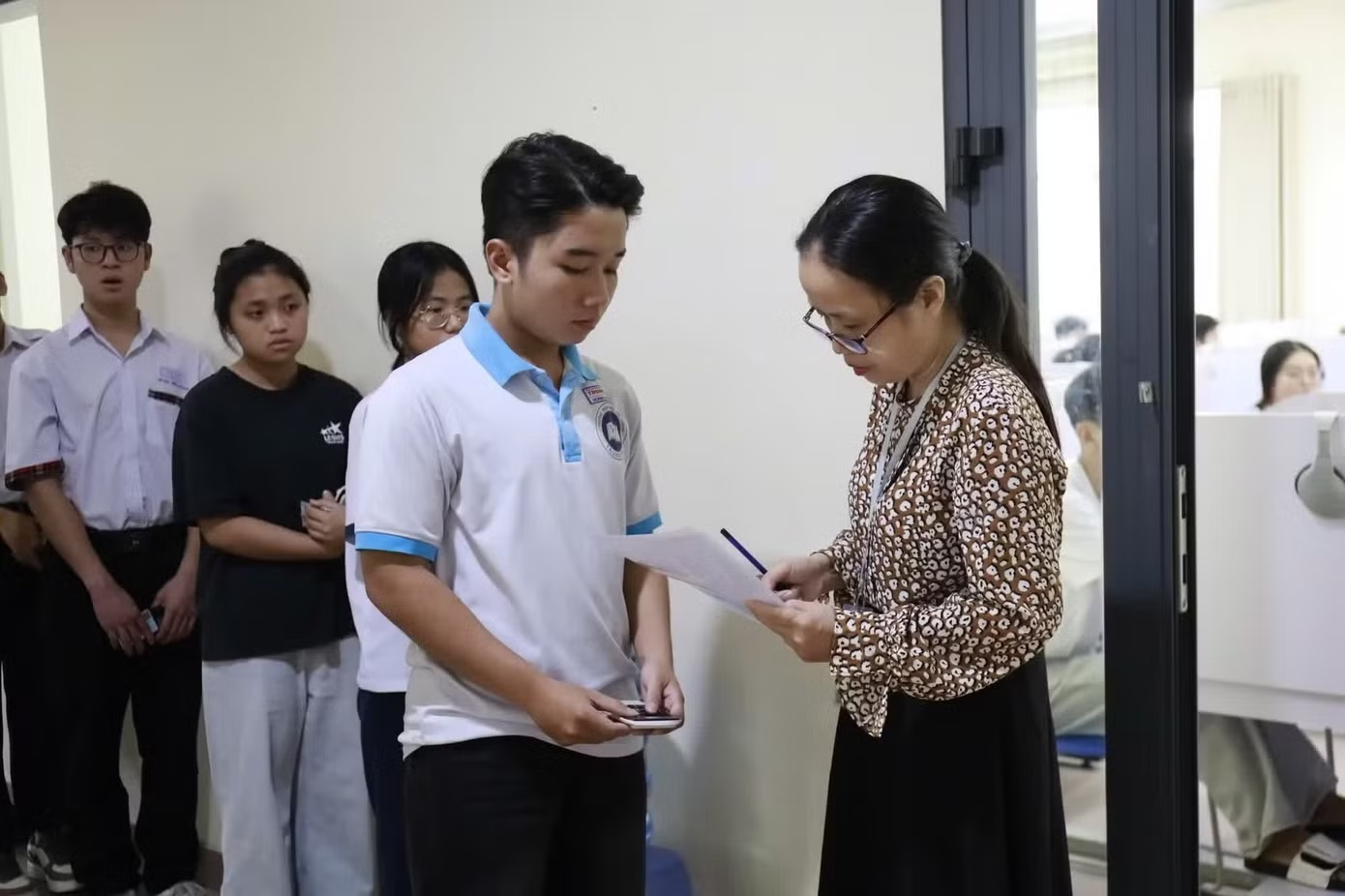
Candidates taking the 2026 high school graduation exam
At the University of Science (Vietnam National University Ho Chi Minh City), the advanced program in Computer Science achieved a score of 29.32/30, equivalent to 97.73/100. Artificial Intelligence achieved a score of 28.68/30, equivalent to 95.60/100; and Microchip Design achieved a score of 27.93/30, equivalent to 93.10/100.
Data-related fields also recorded high scores. The Data Science and Statistics group achieved 27.63/30 points, equivalent to 92.10/100; the advanced Data Science program achieved 27.48/30 points, equivalent to 91.60/100.
At Ho Chi Minh City University of Technology, the Control and Automation Engineering major has the highest admission score, reaching 26.83 points. Microcircuit Design Engineering also requires more than 26 points.
Meanwhile, at the University of Technology (Vietnam National University Ho Chi Minh City), the newly opened Semiconductor Engineering major had the highest admission score in the entire university, reaching 85.8/100 points. In the English-taught program, the Integrated Circuit Design major also led with 85.51 points.
According to Associate Professor Bui Hoai Thang, Head of the Training Department at the University of Technology (Vietnam National University Ho Chi Minh City), the number of applicants to the university in 2026 will increase by 48.75%, while the number of applications will increase by 67.89% compared to 2025.
Besides the increased number of candidates, the school’s application of a new calculation formula with Mathematics weighted by a factor of 2, stricter conversion of international foreign language certificates, and the fact that candidates with IELTS certificates of 6.0 or higher account for up to 30% also impacted the overall cutoff scores.
The fact that a new field like Semiconductor Engineering immediately topped the entrance exam scores reflects societal demand and the trend among students to embrace strategic technology sectors.
At the University of Technology (Vietnam National University, Hanoi), the Computer Science and Technology group of majors, including Data Science (26.85 points), Computer Science (26.86 points), and Computer Engineering (26.63 points), continues to remain in the very high score range. The newly introduced Artificial Intelligence major is also close to this level with 26.26 points.
This boost caused the cut-off scores for various majors to skyrocket.
According to data released by the Ministry of Education and Training, this year, the fields of Science, Technology, Engineering, and Mathematics have created a real “craze,” attracting 476,590 applicants.
Of these, more than 331,000 candidates decided to place nearly 1.3 million applications in majors under category code 179 (a group of majors eligible for scholarship support packages ranging from 3.7 to 5.5 million VND per month according to the new Government Decree).
Professor Vu Van Yem, Vice Director of Hanoi University of Science and Technology, stated that the admission scores for Hanoi University of Science and Technology’s training programs have generally increased compared to 2025, but the increase is particularly noticeable in STEM fields. Explaining this phenomenon, Professor Vu Van Yem attributed it to the effects of the government’s scholarship policy as well as the demands of the labor market.
According to Associate Professor Bui Hoai Thang, Head of the Training Department at the University of Technology (Vietnam National University Ho Chi Minh City), the number of candidates and applications to the university in 2026 will increase by more than 48% in terms of the number of candidates and approximately 69% in terms of the number of applications compared to 2025.
Explaining this phenomenon, Associate Professor Thang suggested that the scholarship policy under Government Decree 179 has created a strong incentive, causing candidates to flock to this field of study. Even though the university has implemented a new calculation formula (mathematics weighted by a factor of 2) and tightened the conversion of international foreign language certificates, the admission scores have still increased.
One noteworthy point in this year’s admissions is the outstanding foreign language proficiency of the candidates. Associate Professor Thang stated that currently, more than 55% of newly admitted students already possess international foreign language certificates that meet the university’s graduation requirements upon enrollment.
The use of foreign language certificates by candidates for admission not only helps improve the quality of incoming students but also demonstrates their thorough preparation to access global knowledge. This is also why the already high admission scores for these majors have become even more competitive.
Associate Professor Thang stated that, in preparation for these new and important academic programs, the school has made thorough preparations in terms of facilities, teaching staff, and especially close cooperation with leading businesses to ensure the best practical training and internship environment for students.
Despite the strong appeal of the technology sector, Mr. Thang believes there’s no need to worry too much because while the number of applicants has increased, the enrollment quota has not risen significantly. This is because training in these fields requires substantial investment in equipment, facilities, and human resources. Controlling the enrollment quota ensures that every graduate meets the stringent requirements of the labor market.
For students preparing for the entrance exam next year, Associate Professor Thang advises against worrying about the high cut-off scores. Instead, they should understand their own abilities and prepare a solid foundation of knowledge to confidently enter university.
To attract talented students, we need a policy that focuses on job placement.
According to Mr. Nguyen Khac Ngoc, a chemistry teacher in Hanoi, in the context of increasingly expensive university tuition fees in major cities, STEM scholarships are a significant boost to attract talented students to study science, engineering, and technology fields that the country urgently needs in its new development phase.
However, for this trend to become sustainable in the years to come and attract more and more talented students, it needs to be complemented by other policies. For example, increased investment in this field at the macro level is needed to create high-level job opportunities that generate significant economic value. While the current scholarship support is very valuable to students, it can hardly compare to the high income they can earn after graduation.
In addition, according to experts, solutions are needed to encourage and improve the quality of teaching natural science subjects at the lower secondary level to attract students to register for these subjects among the elective subjects at the upper secondary level.
In 2026, the Ministry of Education and Training announced a list of 111 training programs belonging to 15 groups of key basic sciences, engineering, and strategic technologies that will be eligible for scholarships under Government Decree 179.
The scholarship policy aims to develop high-quality human resources in the country’s priority sectors. Students studying in the listed fields will receive support ranging from VND 3.7 million to VND 5.5 million per month, depending on the specific field of study. The maximum scholarship duration is 4 years for bachelor’s programs and 5 years for engineering programs.
High entrance scores do not necessarily determine an engineer’s competence.
The allure of technology-related fields raises another question: how should high-scoring applicants be prepared to meet job demands after graduation?
According to Associate Professor Dr. Nguyen Tan Tran Minh Khang, high entrance scores are an advantage, but only the starting point. The important thing is that the training process must transform the quality of the entrance into the practical competencies of the students.

Students of the University of Technology (Vietnam National University Ho Chi Minh City)
The competitiveness of a newly graduated engineer today is determined by a combination of a solid professional foundation, problem-solving skills, mastery of new technologies, foreign language proficiency, and the ability to work in a multidisciplinary environment.
“Especially with AI, technology changes very rapidly, so the ability to learn and adapt will be a crucial factor,” Mr. Khang said.
For newly admitted students, Associate Professor Dr. Nguyen Tan Tran Minh Khang believes that they don’t need to rush to adopt too many new tools. The most important thing is to first build a solid foundation in mathematics, programming, algorithms, data, and English; while also developing critical thinking skills, teamwork abilities, and early participation in practical research projects and activities.
“In the field of technology, long-term advantage doesn’t lie in knowing a tool earlier than others, but in the ability to continuously learn new things, deeply understand problems, and use technology to create value,” Mr. Khang stated.
Source: https://tienphong.vn/vi-sao-nhom-nganh-cong-nghe-mui-nhon-lap-dinh-diem-chuan-cao-chot-vot-post1866660.tpo
