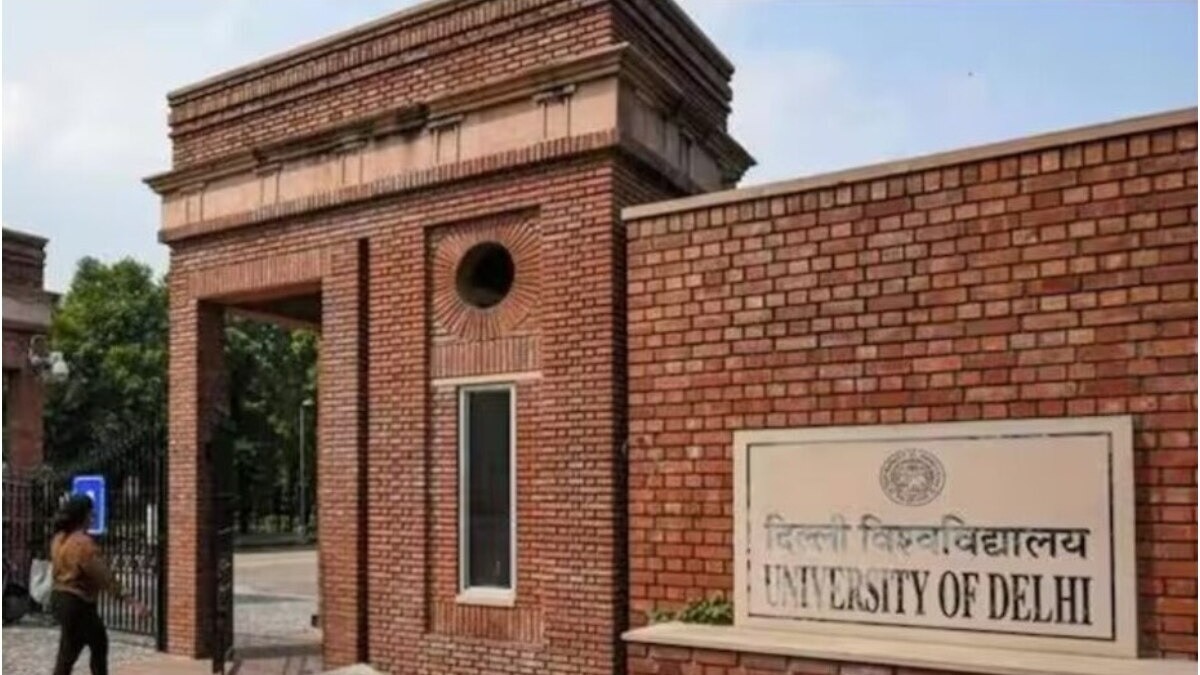
Delhi University’s undergraduate admissions have seen a notable change in applicants’ college preferences this year, reflecting an evolving approach by students under the Common Seat Allocation System (CSAS). For the first time in several years, Dyal Singh College has secured a place among the six most preferred colleges, while Sri Venkateswara College has climbed into the top tier of student choices.
This reshuffle has displaced traditional favourites such as Shri Ram College of Commerce (SRCC), St Stephen’s College and Miranda House from the top five preference list, as reported by Indian Express.
The shift in college rankings comes as the university records more than 2.18 lakh completed registrations for undergraduate admissions. Female applicants continue to outnumber their male counterparts, and BCom (Honours) remains the most popular undergraduate programme among aspirants.
Despite the emerging trends, university officials have urged caution, noting that it is too early to draw firm conclusions. With the admission process still in progress, they said students’ preferences and the overall allocation pattern may continue to change as seat allotments proceed.
COLLEGE PREFERENCES UNDERGO A MAJOR RESET
The latest preference trends suggest that Delhi University’s long-established order of most sought-after colleges is undergoing a gradual transformation under the Common Seat Allocation System (CSAS). Introduced in 2022 following the adoption of the Common University Entrance Test (CUET), the system has significantly changed how applicants approach the admission process.
Kirori Mal College continues to remain one of the university’s most preferred institutions, while Sri Venkateswara College, Ramjas College and Dyal Singh College have recorded a marked rise in popularity, securing places among the top choices.
Meanwhile, colleges that have traditionally dominated student preference lists, including Shri Ram College of Commerce (SRCC), St Stephen’s College and Miranda House, no longer occupy the top five positions.
According to university officials, the changing preference pattern reflects a more calculated admission strategy among candidates. With CUET scores available before preference submission, applicants are making informed decisions by balancing a college’s reputation with factors such as past admission trends, seat availability and their chances of securing a seat in the desired programme.
SEAT AVAILABILITY EMERGES AS A KEY FACTOR
University officials believe that seat capacity is likely to be one of the key factors driving this year’s shift in college preferences. They pointed out that Dyal Singh College offers around 800 more seats than St Stephen’s College, making it a more viable option for many applicants seeking to maximise their chances of securing admission.
Officials stressed that it is still too early to draw firm conclusions, as the admission process is ongoing. However, they noted that under the CUET-CSAS admission system, students appear to be factoring in seat availability more carefully alongside a college’s reputation, suggesting a more pragmatic and data-driven approach to finalising their preferences.
COMMERCE CONTINUES TO DOMINATE COURSE CHOICES
While college preferences have undergone noticeable changes, programme preferences have remained largely unchanged.
BCom (Honours) continues to be Delhi University’s most preferred undergraduate programme, receiving 48,336 first-choice preferences, followed by BA (Honours) Political Science and BSc (Honours) Zoology.
Commerce courses continue to dominate overall preferences, with BCom (Honours) and BCom leading the charts, followed by BA (Honours) English, BA (Honours) Political Science, the History-Political Science combination under the BA Programme, BA (Honours) History and BSc (Honours) Zoology.
Data from the previous admission cycle reflects a similar trend, with BCom (Honours) attracting 19.90 lakh programme preferences, followed by BCom with 15.26 lakh and BA (Honours) English with 12.23 lakh preferences.
WOMEN OUTNUMBER MEN AS REGISTRATIONS CROSS 2.18 LAKH
The admission process continues to witness robust participation.
According to the latest data, 2,73,751 candidates registered on the CSAS portal, of whom 2,18,284 completed the registration process, while more than 2.06 lakh applicants submitted their programme and college preferences.
Women continue to dominate the applicant pool, with 1,20,509 women completing registrations compared with 97,775 men, accounting for just over 53 per cent of registered candidates.
Competition remains intense, with more than two lakh aspirants competing for nearly 71,600 undergraduate seats across 73 programmes offered by 69 colleges and academic departments. The university is also offering nearly 150 BA Programme combinations.
SIMULATED RANKS RELEASED; FIRST ALLOCATION ON JULY 16
Delhi University has released simulated ranks based on candidates’ CUET scores and submitted programme preferences, allowing applicants to gauge their likely admission prospects before the first round of seat allocation.
Candidates can revise their programme and college preferences until 4.59 pm on July 13. The first CSAS allocation list will be announced on July 16, after which selected candidates must accept their allotted seats by July 18.
Colleges will complete document verification by July 20, while the last date for fee payment in the first round is July 21. The second allocation list is scheduled to be released on July 25.
A SHIFT IN ADMISSION STRATEGY
The latest preference trends suggest that Delhi University’s admission landscape is gradually changing under the CUET-CSAS regime. While institutional prestige continues to influence applicants, students appear to be making increasingly calculated choices by balancing reputation with seat availability and admission probability.
The rise of colleges such as Dyal Singh and Sri Venkateswara underscores this shift, indicating that for many aspirants, securing admission to a preferred course is becoming just as important as gaining entry to a traditionally sought-after college.
– Ends
