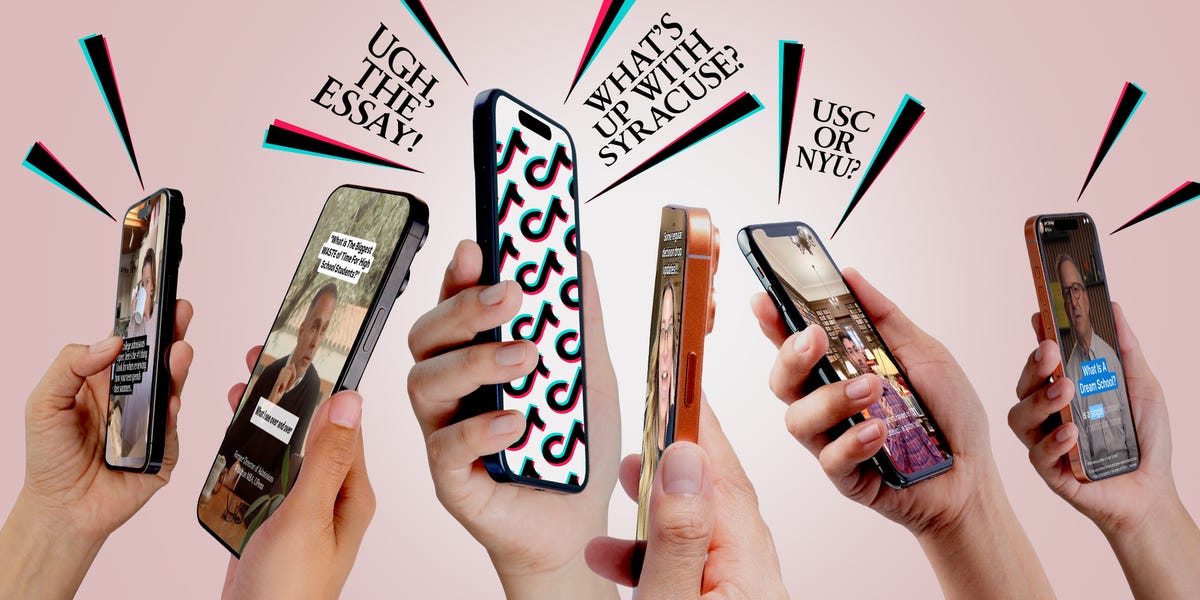
When she first started making videos for social media a couple of years ago, Hollee Becker thought her audience would be students curious about the college admissions process. Becker, a New Jersey–based college admissions coach and freelance journalist, figured the videos would be both a good way to market her business and respond to the deluge of questions she received from high school juniors and seniors. Her own children told her to start on TikTok, where she’d reach the most kids; she soon expanded to Instagram. At first Becker measured the success of her videos by their views and the number of comments and DMs she received in response. But then she saw something new happening: She’d post a video about a deadline approaching for a certain school or the common application process, and within moments, the shares of that video would start to jump. “I knew that was parents seeing the video and sharing it with their kids,” says Becker.
It makes sense: There’s only so many times a parent can poke their head into a child’s bedroom and ask, in a studiously nonchalant tone, “How’s it going? Make any progress on your supplemental form?” Maybe an Instagram share would be the gentle nudge they needed.
It’s no surprise that the cottage industry of college admissions counseling has followed its customers—high school students and their equally invested parents—to social media, but the sheer volume of content now floating around about the college application process is staggering. “I do this for a living and I’m overwhelmed by it,” says Jeff Selingo, a veteran higher education journalist who has written several books about the college application process (and, yes, makes reels).
And it’s not just TikTok and Instagram: Facebook has its own content and groups (perhaps for helicopter grandparents?), and LinkedIn, Pinterest, Reddit, and YouTube are all fertile ground as well. Beyond journalists and college admissions advisors, there are testing tutors; essay coaches; parents who’ve gotten a kid or two into college and hung out their own shingle as mentors for hire; and Ivy League sophomores claiming they know the secret to getting into Yale. This content umbrella can also stretch to include BamaTok and all the aspiring influencers who are currently students making videos about life on campus. And like any thriving corner of social media, this one is rife with copycats and snake-oil salesmen, and ultimately proof that a vulnerable audience is a ravenous one. “It’s parents who want to control a situation that’s not controllable, and kids who are just looking for any information,” says Becker.
All this content represents a new era for college advising and admissions. A generation ago, when the parents now sharing Becker’s videos were applying to college themselves, students and their families got their information from a finite number of analog sources: School counselors, of course; fellow students and parents; resources like the Fiske Guide; and colleges themselves. “The colleges and universities really managed the flow of information,” says Selingo.
“Where we are today is a huge shift away from waiting to be spoon fed by counselors, schools, by friends, and the water cooler,” says Lisa McLaughlin, a 30-year veteran of the industry who has worked on both the secondary and higher education side of admissions and now coaches parents through the process. “I always ask kids ‘Where do you get your admissions information from?’ They used to say ‘last year’s graduating class.’ Now it’s ‘I’m getting it from TikTok. I’m getting it from Reddit.’”
By the 2000s and 2010s, college admissions had already begun to evolve. Entrepreneurial high school counselors and admissions officers had realized there was a hunger for more guidance and hung out their shingles as admissions coaches. Many started YouTube channels. Parent Facebook groups proliferated (McLaughlin got her start on social media doing Facebook Lives). Audrey Wisch, who graduated from high school in 2019, says she could see the origins of this social media explosion just beginning. “When I was applying, I followed a few kids I knew to see what their dorms looked like,” she remembers with a laugh. (Wisch went to Stanford, where she founded a company called Curious Cardinals, a platform that matches high school students with “near peer” mentors in college and graduate school to nurture their talents and passions. She left college to pursue the business full time. Though she and her co-founders did not set out to get involved in the admissions juggernaut, it became an inevitable part of her business, she says, since students were so hungry for advice.)
Then came Covid, driving every part of the application and admissions process online, throwing testing into disarray and raising everyone’s anxiety level. You know the rest of the story: Stuck at home, everyone spent more time online and on their phones. The simultaneous rise of TikTok (and Instagram’s ensuing pivot to Reels) super-charged the short-form video. Everyone who had been making hour-long YouTube videos about how to navigate the Common Application had to figure out how to distill their message down into 90-second videos. “To be successful now, you need to say something that stops people scrolling,” says Wisch. “You need to earn every second of their time. You need to say something controversial or perhaps ruffle feathers, something that makes people feel something.”
In some ways, the college admissions process was tailor made for this new information marketplace. “Social media is fears and dreams,” says Wisch. “And college epitomizes the intersection of that.”
The trouble, say multiple admissions veterans, is that misinformation is rampant and fearmongering is powerful and grabby. One rising high school senior I spoke to says he has watched many dozens of videos that all follow a common formula: The content creator deconstructs an application, talking through that student’s test scores, their GPA, their extracurriculars, and giving a quick summary of their essay topic. They show the list of colleges that student applied to, and where they did and did not get in. The outcomes follow a typical pattern: Impressive student with impressive scores and grades is roundly rejected from all their dream schools. “It can be demoralizing,” the senior says, “but I know these creators are all basically doing it to sell their courses.”
“The goal is very often to make you feel like you’re not enough—you’re not enough as a parent, your child is not enough as a student and a person,” says McLaughlin. “I’m consistently trying to check that.”
As Hollee Becker learned, this content has found a fertile audience in parents. “Since Covid, I’ve seen a lot more parents involved in their kids’ applications,” she says. Jenna Schebell, a college admissions consultant who has also worked on both the secondary and higher education sides of the process, started making videos for Instagram three years ago when she launched her business, the College Navigators. “I initially thought I was speaking to students because I was framing everything for them,” Schebell says. “But then I realized I was talking to the Moms. It was all women 45 to 55.”
Selingo thinks he understands what’s fueling this parental wave of anxiety. “Parents are worried about money and they’re worried about the world their kids are headed into,” he notes. “In previous generations, most people were at an age when they were really hitting their stride professionally as their kids were applying to college. But I have met so many parents this past year who were just laid off or who are worried about losing their job. Or are worried about AI taking their job. They’re thinking, ‘Wait, I’m sending my own kid out into this now?’ They want assurances that college is a good investment.”
Despite the miasma of worry that seems to permeate everything, many content creators are still fierce advocates for the democratization of data and information that social media represents. “I’m a big believer in information. And social media is a lot of information,” says Thomas Caleel, a college admissions coach and founder of a company called Admittedly who is the former director of MBA admissions at the Wharton School of the University of Pennsylvania. “For all the drawbacks, there is an inherent beauty in platforms that allow for this interaction and exchange of ideas that is extremely powerful.”
Like many of the entrepreneurial admissions coaches I spoke with, Caleel regrets that his services are expensive and by nature limited. Social media allows him to reach a much wider range of students who can benefit from his expertise and perspective. Kids, he also believes, are resilient. “People think it’s students who are fragile, but most of the feelings I hurt belong to parents,” he says. “Young adults understand that the bar is high and they rise to the challenge or they say ‘I respect you for telling me the truth.’”
Becker points out that if kids are going to spend hours on TikTok or Instagram, they could do worse than consume videos about optimizing your college application. “I’d rather my kids be watching college admission content on social media than other things,” she says. “In fact, I would recommend it. They should be as educated about college admissions as they are about the latest episode of Love Island.”
It’s not just students and their families who are at the mercy of these platforms, but colleges and universities too. “I think the schools that can play the game of attention are going to do really well,” says Schebell. “They’re the ones that are already booming and getting more applicants.” She points out that RushTok, the viral phenomenon where college students share their experiences with sorority recruitment, particularly at the University of Alabama, seems to have boosted applications to those schools.
Changing a school’s reputation used to be a slow process that was difficult to track or understand—sure the U.S. News & World Report rankings could shift from year to year, but the schools at the top rarely changed much. Now, Vanderbilt is as hard to get into as an Ivy. Social media videos about Vandy are probably not the primary reason for that shift, but they are more influential than anyone could have predicted. Schools like the University of Miami and Tulane, Schebell says, “run pretty hardcore social media accounts and it’s paying off in application numbers. This is how kids are being introduced to those schools, through the stories they’re able to tell on social media.”
So what’s the best way to take advantage of this all-you-can-eat buffet of information about the college application process? First, don’t gorge yourself. “I talk a lot about protecting your attention,” says McLaughlin. “Look for people who align with your values. Clean up your feed, train your algorithm. ”
Second, don’t let your anxieties undermine your judgment. McLaughlin counsels her clients to remember that if something sounds outlandish, it probably is. “Parents will call me and say ‘well, I heard this.’ And it’s a crazy rumor. And I’ll say ‘does that feel right to you?’ And they’ll say ‘no, it doesn’t.’ and I’ll say ‘well, you have your answer.’”
Third, communicate openly with your children about what they’re watching on social media. “Ask your kids to tell you what they’re seeing,” says Becker. “If it’s something you haven’t heard about before, have them help you disprove it or confirm it.” It’s a potent lesson in media literacy that will far outlast anything they learn about the application process.
Finally, remember that the point of any application is for a student to demonstrate to a college who they are as an individual, and social media works actively against individuality. “Social media is all about getting attention, but it flattens everything,” says Schebell. “College admissions is the same. But you don’t want to be the same as everyone. You want to stand out.”
Wisch, who is herself Gen Z and a social media native from an early age, has the same advice. “What I want to say to kids is, ‘Put the phone away’,” she says. “It’s the drug in your pocket. If you spend too much time on it, you lose your voice, your sense of time, your sense of agency. Find a few people who help you identify what you care about, check in with them once a quarter, and then go be yourself.”

