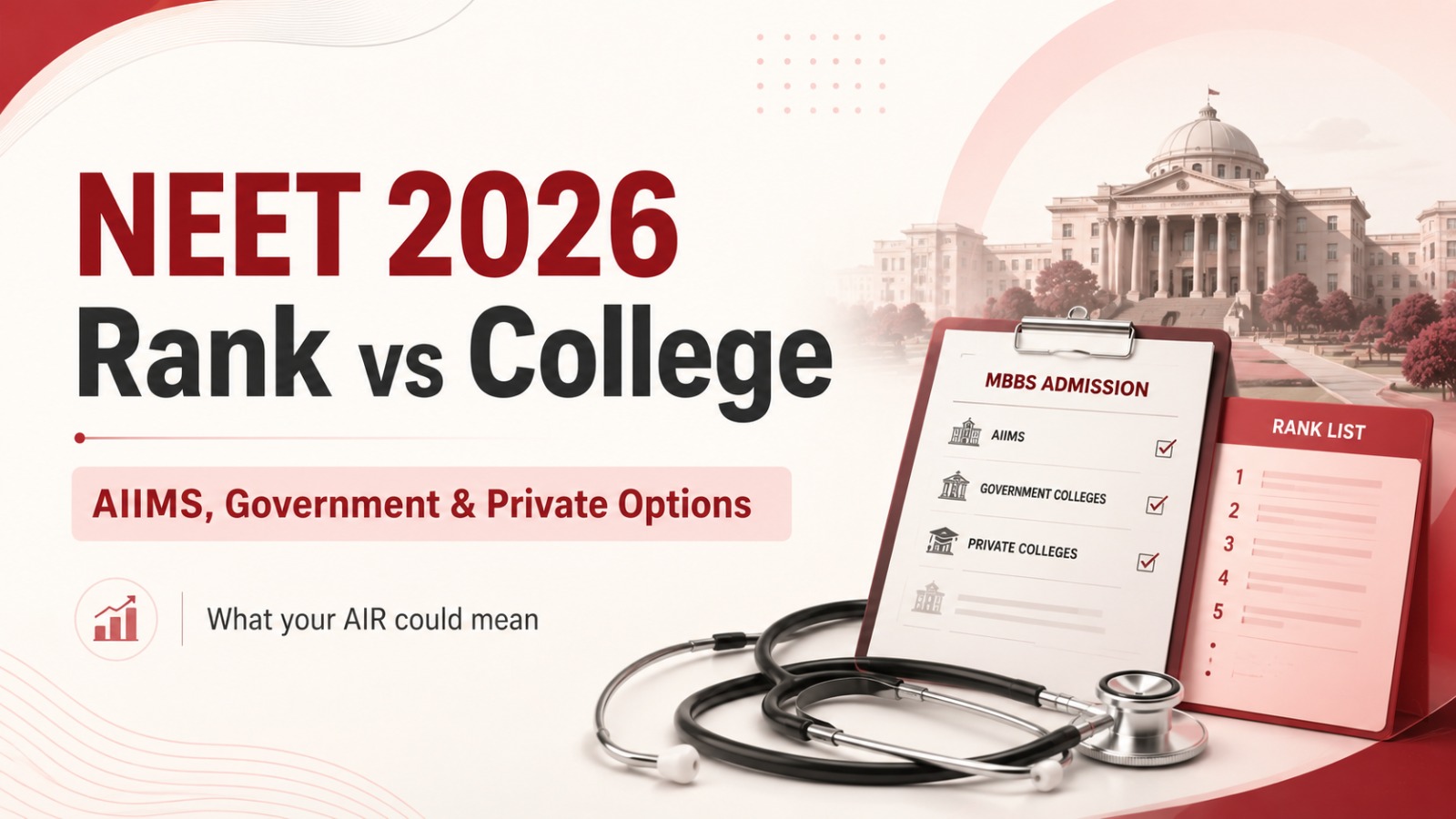
For NEET 2026 candidates, the conversation is now shifting from marks to college choices. A score may show how a student performed in the examination, but the All India Rank, or AIR, is expected to play the central role during seat allotment.
The college available to a candidate will not depend on rank alone. Category, domicile eligibility, reservation rules, the number of available seats, counselling round and the order in which colleges are selected can all influence the final result.
That makes rank-based college predictions useful for planning, but not conclusive. Previous opening and closing ranks can help candidates build a practical preference list, although actual allotments may move in either direction during counselling.
Top ranks remain strongly placed for AIIMS and leading government colleges
Candidates ranked between 1 and 100 are expected to have the strongest opportunity for admission to top AIIMS institutions.
The competition remains favourable for several highly sought-after colleges up to AIR 500, where the likely pool includes AIIMS and premier government medical colleges. Between AIR 501 and 1,000, candidates may consider AIIMS campuses, JIPMER and other leading government institutions, depending on the counselling outcome.
The range from AIR 1,001 to 5,000 is expected to remain important for premier and established government medical colleges. Candidates between 5,001 and 20,000 may also have government MBBS options through the All India Quota or state counselling, although the available colleges are likely to vary considerably.
Expected NEET 2026 college options by AIR
| All India Rank | Expected college options | Likely course |
|---|---|---|
| 1 to 100 | Top AIIMS institutions | MBBS |
| 101 to 500 | AIIMS and premier government colleges | MBBS |
| 501 to 1,000 | AIIMS, JIPMER and leading government colleges | MBBS |
| 1,001 to 3,000 | Premier government medical colleges | MBBS |
| 3,001 to 5,000 | Government medical colleges | MBBS |
| 5,001 to 10,000 | Established government medical colleges | MBBS |
| 10,001 to 20,000 | Government colleges through AIQ or state quota | MBBS |
| 20,001 to 35,000 | Government and state medical colleges | MBBS |
| 35,001 to 50,000 | State quota government seats or private colleges | MBBS |
| 50,001 to 75,000 | State government and private medical colleges | MBBS |
| 75,001 to 1,00,000 | Private medical colleges | MBBS |
| 1,00,001 to 1,50,000 | Private colleges and deemed universities | MBBS |
| 1,50,001 to 2,50,000 | Private medical and dental colleges | MBBS or BDS |
| Above 2,50,000 | Private colleges, AYUSH and other medical courses | Limited MBBS, BDS or AYUSH |
These ranges should be treated as broad counselling indicators. They do not represent confirmed closing ranks for individual colleges.
Government MBBS opportunities may extend beyond the top 20,000
The strongest government college prospects are expected among candidates within the first 5,000 ranks. However, admission opportunities may continue well beyond that point.
Candidates ranked up to 20,000 may remain in contention for government colleges through national or state-level counselling. In some states and categories, government MBBS opportunities may extend towards AIR 50,000.
This variation is largely linked to domicile rules, reservation benefits, state-level competition and the number of seats available in each counselling round.
A candidate with a comparatively lower AIR may secure a government seat under one state quota while another candidate with a better rank may face tougher competition in a different state. For this reason, a single national rank range cannot predict the same outcome for every student.
AIQ and state quota can produce different outcomes
The counselling structure divides opportunities between the All India Quota and state quota systems.
Around 15 per cent of government MBBS seats are considered under the All India Quota, with counselling conducted by the Medical Counselling Committee. Competition in this pool is national.
The remaining government seats are largely handled through state counselling. These seats generally form the larger share of the admission pool, but domicile and state-specific eligibility requirements can apply.
Candidates who qualify for both processes should consider registering for AIQ and their respective state counselling. Depending on the rank, category and state, participating in both may widen the number of realistic choices.
Category and domicile remain critical
The same AIR can lead to different outcomes for candidates from different categories.
General-category candidates usually face the highest competition. OBC and EWS applicants may receive opportunities through their respective reservation provisions, while SC and ST closing ranks can differ because of reserved seat distribution.
Domicile can be equally important. Many state counselling systems reserve a substantial portion of seats for eligible residents. Candidates should therefore check domicile rules before assuming that a college visible in a previous cutoff list is open to them.
Category benefits also depend on valid documentation. Any mismatch in certificates, personal information or eligibility records may affect counselling participation.
Private colleges become more prominent after AIR 50,000
Candidates who do not secure a government seat may find a wider range of private options as the rank moves beyond 50,000.
Between AIR 50,001 and 75,000, possible choices may include state government colleges in limited circumstances as well as private medical institutions. Private colleges become the more likely MBBS route between AIR 75,001 and 1,50,000.
Candidates ranked between 1,50,001 and 2,50,000 may need to consider a mix of private MBBS seats, BDS programmes and other available courses. Above AIR 2,50,000, MBBS options may be limited, with BDS, AYUSH and related programmes forming a larger part of the available pool.
Fees require careful attention at this stage. Private and deemed university charges can differ substantially, so candidates should examine tuition costs, hostel expenses, location and refund rules before locking their choices.
Choice filling could decide whether a candidate converts a rank into a seat
A good rank does not automatically produce the best available college. The preference order submitted during counselling can directly influence allotment.
Candidates should place colleges in the order in which they genuinely want to join them, rather than attempting to predict which option the system may assign. A sensible list should include aspirational colleges, realistic choices and safer alternatives.
Previous closing ranks can help organise that list, but candidates should not restrict themselves to only those colleges that closed near their AIR in the first round. Cutoffs can shift in later rounds as students upgrade, withdraw or move between counselling systems.
Round 2, mop-up and stray vacancy rounds may therefore create opportunities that were unavailable earlier.
Mistakes that can reduce admission chances
One of the most common errors is relying only on marks and ignoring AIR. Seat allotment is rank-driven, so a college list built solely around marks may be misleading.
Candidates may also lose opportunities by overlooking state quota eligibility, arranging choices in the wrong order or leaving out colleges that appear slightly ambitious.
Skipping later counselling rounds is another risk. Although no candidate should assume that cutoffs will fall, vacancies and movement between institutions can change the available options.
Financial planning must also happen before choice locking. Selecting a private college without reviewing its complete fee structure can leave a family with an unaffordable allotment.
What candidates should do before counselling
Candidates should first verify the personal, category and rank details shown on their scorecards. They should then review the eligibility requirements for MCC counselling and the relevant state process.
A working college list should be prepared using AIR, category, domicile and previous closing ranks. Necessary certificates should be kept ready, particularly domicile, reservation, identity and academic documents.
Most importantly, students should continue checking official counselling schedules and seat allotment notices. Rank predictions are planning tools. The final decision will come only through the authorised counselling process.
(Inputs From Physics Wallah)
Also Read: IT Stocks Rally as Q1 Results Ease Growth Concerns; Infosys, Tech Mahindra and HCL Tech Lead Gains
