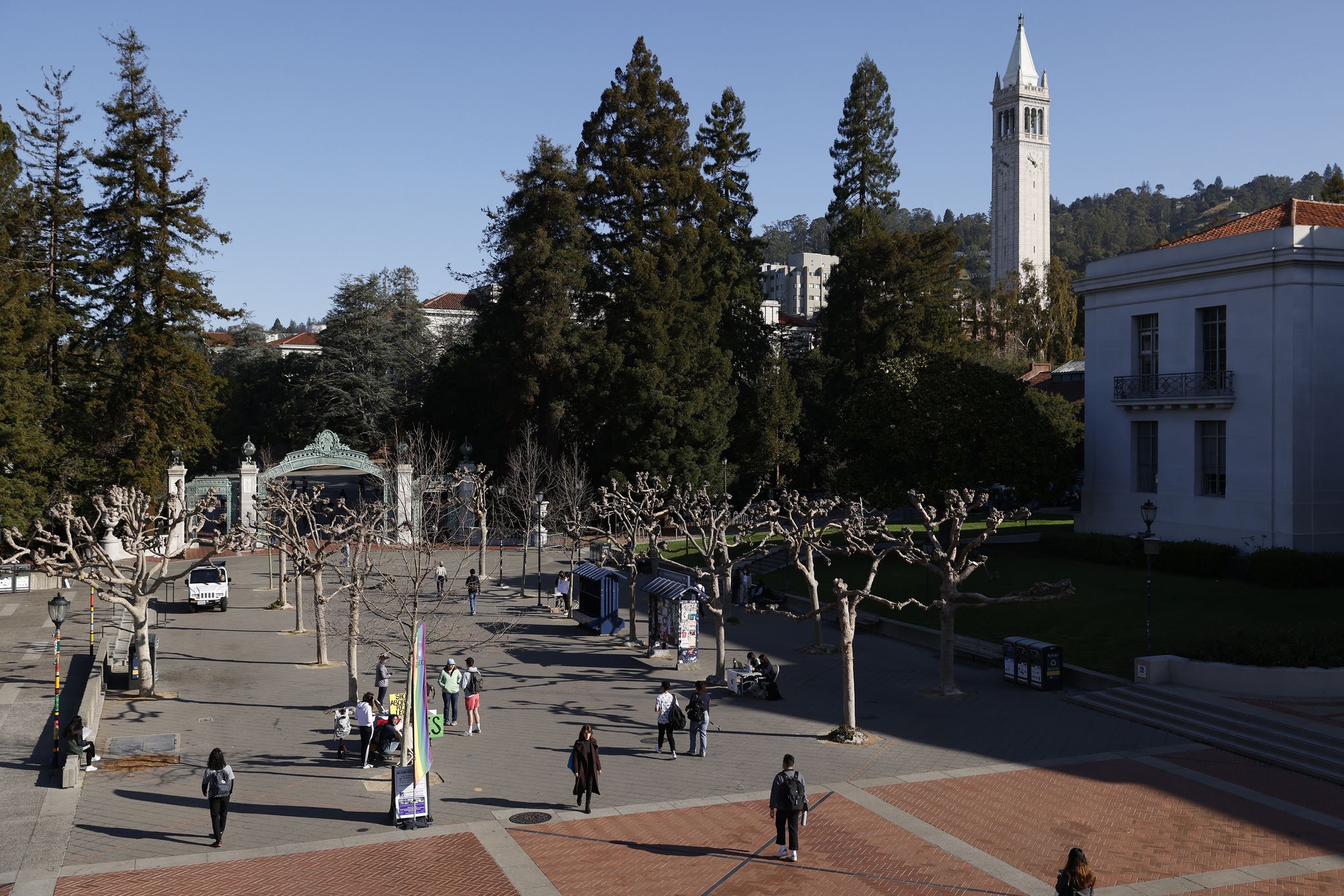

Students walk through Sproul Plaza at UC Berkeley. The campus admitted fewer California freshmen for the third consecutive year, even as the UC system offered admission to a record number of state residents.
The University of California admitted more than 102,000 of the state’s high school students for this fall — the most in its history — even as flagship UC Berkeley continued a four-year trend of inviting fewer Californians to enroll as freshmen.
The new admissions report, released Wednesday, shows that across all nine undergraduate campuses, UC admitted a record 185,632 applicants from California and around the world, including 153,272 freshmen and 32,360 transfer students.
This year’s report continues a years-long increase in admissions of freshmen from across the state. Invitees from California grew by nearly 48% since 2017, or nearly 33,000 more of the state’s high school students. That’s a bump of 1,458 more Californians admitted than last year.
Article continues below this ad
UC’s overall admissions rate for first-year applicants from California is 78% — up from 77% in 2025.
“The record number of California students we’re welcoming this year reflects UC’s enduring commitment to expanding opportunity while preparing the next generation of leaders, innovators, educators and public servants,” James Milliken, UC’s president, said in a statement.
It didn’t happen by accident. UC is in the final year of its five-year “compact” with the state, in which the university agreed to increase in-state undergraduates by at least 1% a year and make it easier for community college students to transfer in.
This year, UC admitted more California community college students than ever: 29,372, a 6% increase over last year.
Article continues below this ad
Under the compact, in return for prioritizing Californians, the state would provide yearly funding increases of about 5%.
UC’s new admissions report reflects only students who have been invited to enroll — a number that is always larger than the number who actually do. Nearly half of students admitted to UC Berkeley and UCLA typically enroll there, for example, while some other campuses typically enroll fewer than 20% of admitted students.
Meanwhile, UC says it is on track to increase by 17,000 its total number of in-state undergraduates by 2030.
Yet that trend is not reflected at UC Berkeley, considered one of the world’s best public research institutions. The campus admitted just 9,445 freshmen from California this year – a 14% decrease since 2023, when nearly 11,000 state residents were accepted. Since then, the number of freshmen applicants admitted from California has dropped steadily. In all, 68% of those admitted to UC Berkeley this year come from a California high school.
Article continues below this ad
But it’s a rosier picture for state residents transferring from other schools to UC Berkeley as juniors. Those numbers grew by 176 students to 4,344 since last fall — a 4% increase.
UCLA, the university’s other premier campus, saw a 6% uptick in California first-year admissions, reversing last year’s decline.
The new report offers a wide range of admission trend lines, from gender identity (1% of admits are nonbinary) to campus-specific rates by race and ethnicity (UC Santa Cruz admitted more American Indian applicants than any other campus).
UC-watchers will also be able to look at what’s happening with admissions of non-California residents, who pay 3.5 times the base tuition of in-state students: $54,858 vs. $15,588. Over the years, it’s a been a temptation for UC to boost its budget by opening its doors to more and more of the higher-paying nonresident students.
But Californians put their foot down about a decade ago, which led the state to incentivize UC with agreements that favor in-state admissions. UC also agreed to cap out-of-state enrollments.
Article continues below this ad
Still, UC has been offering admission to increasing numbers of nonresidents.
This year, UC admitted 27,672 freshmen from other states, a 5.7% increase from last year, or 1,489 more students.
But the university is also increasing rates of admissions offers to international students — hoping to keep numbers of foreign students steady amid the chilly reception by the Trump administration, which has threatened to deport students for political activity on campus — or just being from China, the main country of origin for UC’s foreign students — and reduced the amount of time students can remain in the U.S. on a student visa. This year, UC boosted admission of international freshmen by 7.5%, inviting 23,569 first-year students from other countries, up from 21,923 last year.
The new report also reveals other trends among California residents admitted as freshmen:
-
41% of admits would be the first in their family to attend college, down from 42% last year.
-
43% of admits are from low-income families, up from 42% last year.
Article continues below this ad
“This year’s data show once again that a significant number of first-generation and low-income students are getting their shot at the American dream at public universities like UC,” said Han Mi Yoon-Wu, UC’s head of undergraduate admissions.
Here are campus trends among California first-year admits:
-
UCLA admitted the largest proportion of Black students, 7%, and UC Santa Barbara admitted the smallest proportion, at 3%.
-
The two largest ethnic groups admitted to UC Berkeley were Asian Americans (43%) and Latinos (26%).
-
At UC Berkeley, 56% of admits were women, and 38% were men.
-
UC Santa Cruz and UC Santa Barbara tied for admitting the most students identifying as “not low income”: 50% each.
