By the time he was exposed as an impostor in October 2022, William Curry had been living in campus dormitories at Stanford University for nearly 10 months.
Curry, from Birmingham, Alabama, posed as a sophomore studying pre-med at the university until authorities caught up with him removing a TV from one of the dorms.
Revealing that Curry had lived in at least five student residences over the course of a full calendar year, campus newspaper the Stanford Daily reported that “Curry harassed multiple students and was repeatedly removed from campus only to immediately return.”
What makes people pose as students at top universities? If some may have malign intent, others appear to just want to take their place, live out some kind of life, at an iconic institution. So, who are these fraudsters with textbooks tucked under their arms?

A residence hall at Stanford University.
In his book, How to Rule the World: An Education in Power at Stanford University, Theo Baker, the then-Stanford Daily journalist who reported on Curry’s deception, wrote that one freshman recalled him as a “fucking normal as shit” person who baked brownies with other students.
Curry told the Daily that he “honestly, really couldn’t [say]” why he chose to pose as a student. Curry said he was “just living the normal Stanford life, meeting people, socializing, as you do in college.”
“Prestigious universities are powerful status symbols,” Matthew Hornsey, a professor at the University of Queensland Business School who has studied impostors, tells T&C. “For some people, pretending to belong to places like Stanford offers access to admiration and opportunities that are otherwise out of reach. In a sense, they are borrowing an identity that carries instant credibility.”
There is no single profile of an impostor, Hornsey adds. “Some cases appear driven by loneliness, unmet needs for recognition, or a desire for belonging. Others seem driven by more opportunistic or narcissistic motives. Human beings are storytellers, and sometimes people become deeply invested in a story about who they wish they were.”

Stanford’s campus.
Johnathan Walton, author of Anatomy of a Con Artist: The 14 Red Flags to Spot Scammers, Grifters, and Thieves (Penguin Random House), tells T&C that impostors and con artists typically embrace their modes of behavior from a young age. “They get a thrill from scamming people, or creating identities, telling lies, and tricking people into doing things—especially giving them money. No impostor ever believes they will be caught. If they thought that, they would never be engaged in whatever they engage in.”
Whether they are attempting some kind of material fraud, or just assuming a place within an institution or family that holds some kind of allure to them, the discovery of an impostor’s true identity—and their eventual censure and punishment—are inevitable, says Walton. “Cons are like everything in life: they have a beginning, middle and an end—and the career of an impostor or con artist is the same. They think they can continue the ruse forever, but eventually the number is up for everyone. 99 per cent of the time, con artists get caught.”
Curry at Stanford was “a serial manipulator,” Baker writes. “Lies flowed from his mouth as easily as spent breath, building upon one another to erect a tower of elaborate deception… He constructed an alternate reality, then forced those around him to inhabit it.”
While Stanford later admitted to “gaps” in its protocols and promised “an immediate review,” Baker writes the university “all but exonerated” itself by citing “the unique aspects of this case and Mr. Curry’s persistence and ability to ingratiate himself with our student community.”

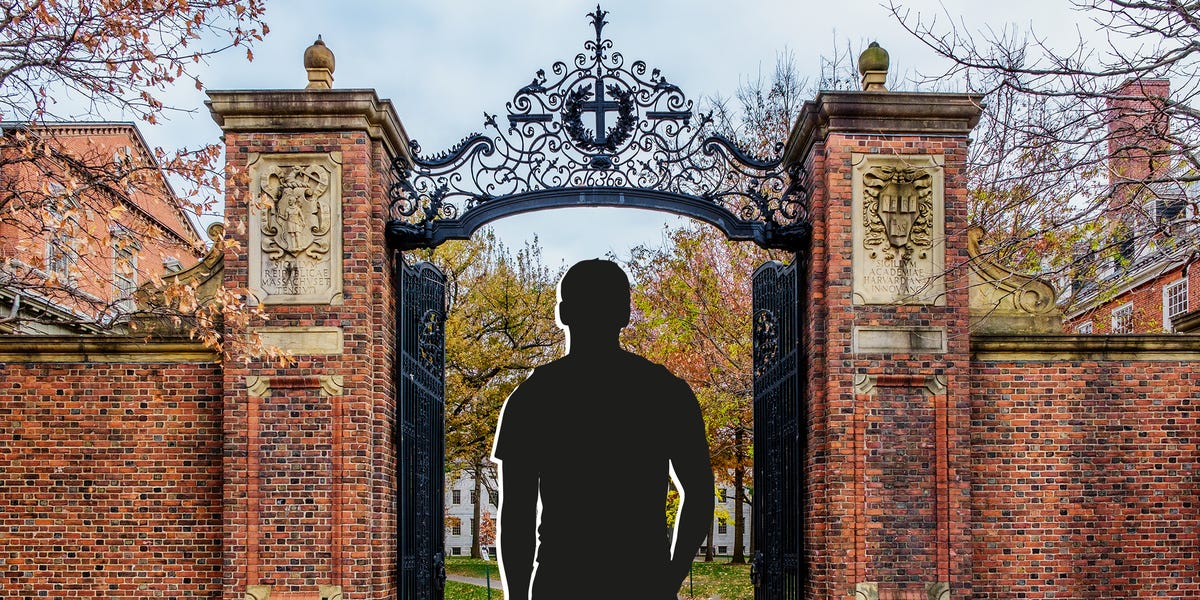
Harvard University entrance gate.
In another 2023 case, the Harvard Independent, under the headline “The Impostor Amongst Us,” reported the presence of a nameless “fake freshman,” citing “their inability to provide proof of acceptance or a verified Harvard ID, their absence from the printed or online registry, and their absence from on-campus dorm living.”
However, the freshman, who the Independent pseudonymously called “Jane,” denied they were a fake student. “My parents went to the Ivy League. I could have gone to Stanford or Yale, but [Harvard was] just a bit different, because I decided to go a different path rather than my entire family.”
“Impostors and con artists are everywhere,” says Walton. “I learned that the hard way with the person who scammed me out of $100,000 and ruined my life. They’re friendly and fun to be with. They know how to push your buttons, and how to win friends.”
Such people have no regard for the people they’re hurting, says Walton, whose book is based on bringing his own con artist to justice, and helping others do the same. “They are not capable of loving anyone but themselves. They get a god-like thrill out of exercising their sense of creation—that is, creating worlds that do not exist and watching with delight as everyone believes those worlds are real.”

Harvard Yard.
At Harvard in 2011, 27-year-old Abe Liu posed as an undergraduate student, staying in the dorms and eating at the school cafeteria. “My mistake was being lonely,” he said. I just played off like I was a student. It got addicting,” Liu told the Harvard Crimson. “It got fun.”
Liu, then a student at Harvard Extension School (the continuing education school of the university), said: “The first lie is like, ‘Oh, I’m a student at the College.’ They always want to know more, so you start telling a lot of little white lies. And then you find yourself integrated into that society.”
“People have a remarkable ability to compartmentalize risk and focus on short-term rewards,” Hornsey says of impostors’ ability to maintain their ruse. “Many probably know, on some level, that the deception can’t last forever, but each successful interaction reinforces the belief that they can keep the performance going longer.”
“You get so deep, you don’t know how to stop it,” Liu said. “At the end of the day, all I wanted to do was to be friends. The people that met me, the people that knew me, know that I never asked them for anything. I never coerced them into anything.”

The Harvard campus in 1963, the year the school was rocked by an assumed-identity scandal.
An even more extreme case of fakery rocked Harvard in 1963, with a student attending the university having assumed the identity of a high school acquaintance. That acquaintance had been accepted by Harvard but had chosen to attend another university. The fake student wrote to Harvard posing as his acquaintance, claiming they had changed their mind—then attended Harvard posing as them.
When his scheme was uncovered, the student was expelled, and Harvard’s faculty voted to expunge their name from the university’s records—the first time it had done so since 1936.
Of course, the extensive and colorful history of impostors isn’t restricted to prestigious places of learning. “Prostitution is often credited as the oldest profession, but I really think scamming is,” says Walton. “The oldest recorded fraud involved a Greek sea merchant called Hegestratos. Throughout history, people have wanted to con other people, or pretend to be other people to get something for themselves.”
Impostors command fascination because of their motives: just why, beyond a material scam if money lies at the root of their deception, do they dissemble in the way they do? Over 40 years since her death in 1984, an air of mystery still surrounds one of history’s most notorious impostors, Anna Anderson, who claimed to be the Grand Duchess Anastasia, the youngest daughter of Russia’s last Tsar. Anderson’s claims were ultimately disproved by DNA testing.
“How shall I tell you who I am?” Anderson said in a 1978 interview. “In which way? Can you tell me that? Can you really prove to me who you are? You can believe it, or you don’t believe it. It doesn’t matter.”

In 2025, Yale removed a student from its freshman class who was accused of falsifying a their application.
More recently, the infamous case of fake heiress Anna Delvey, who stormed and befuddled the New York high society and art scenes (defrauding many hotels, banks and other businesses in the process), garnered acres of newsprint and eventually became a Netflix limited series. “The thing is, I’m not sorry,” Delvey (real name Anna Sorokin) told the New York Times in 2019. “I’d be lying to you and to everyone else and to myself if I said I was sorry for anything. I regret the way I went about certain things.”
“My motive was never money,” Delvey said. “I was power hungry.” She added: “I’m not a good person.”
In 2000, a Frenchman, Christopher Rocancourt, appropriated the Rockefeller name, and swindled several Hamptons residents out of 188,000. (In a 2003 court case, Rocancourt pleaded guilty to four counts of grand larceny, and received a prison sentence.) Another Frenchman, Frédéric Bourdin, impersonated people in five languages in 15 countries, including a missing Texas boy called Nicholas Barclay. In March this year, New York magazine revealed the party-crashing, high society antics of two impostors, variously claiming to be members of the Rockefeller and Cartier dynasties.
The irony surrounding the most famous conman of modern times, Frank Abagnale Jr.—whose life story was adapted into the 2002 movie Catch Me If You Can, starring Leonardo DiCaprio and Tom Hanks—was that Abagnale greatly exaggerated his history of conning, says Walton.

A convicted conman posed as Princeton student twice in the 1990s.
Back on campus, in 2007 Adam B. Wheeler faked his way into Harvard having claimed to have graduated from Phillips Academy in Andover and to have received perfect grades as an MIT freshman, the Harvard Crimson reported. “In fact, he attended a public high school in Delaware and spent two years at Bowdoin College before being suspended for academic dishonesty.”
While studying at Harvard, Wheeler fabricated further tales of academic achievement and was arrested in May 2010, pleading guilty to 20 counts of misdemeanor and felony counts of larceny, identity fraud, falsifying an endorsement or approval, and pretending to hold a degree. A judge ordered Wheeler to pay $45,806 in restitution to Harvard.
In a statement to court, Wheeler said, “I’m deeply sorry that my actions deprived others of the opportunity they rightfully deserved. I’ve been shamed and embarrassed by what I’ve done.”
The Yale Daily News last year reported on an similar incident of a first-year student falsifying high school transcripts, recommendation letters, and financial records to gain entry there. A Yale spokesperson said that the Davenport College first year, later named as Katherina Lynn, had “submitted falsified information” and “misrepresented themselves” in their application.
At Princeton, there is a long history of fake or invented students, usually conjured by existing students as pranks—including one figure, Henry Fairfax, who peppered the university’s population with Valentine’s cards during the 1970s and ’80s. Then, in the early ’90s, a very real fake student named Alexi Indris-Santana—supposedly an elite runner and self-educated ranch-hand (who claimed to sleep under the Utah stars with his horse, Good Enough)—was revealed to be convicted conman James Arthur Hogue.
After serving a nine-month prison sentence, Hogue returned to Princeton in 1995 posing as another self-created character, geology PhD student James/Jim MacAuthor. After being exposed a second time, Hogue was banned from Princeton’s campus for life.
The internet age, and the proliferating impact of AI, mean impostors have “the easiest time creating new identities and scamming others,” Walton tells T&C. “There are tools including websites and social media accounts to create identities that are not real.”
“Impostors and con artists are everywhere—cap, underline, italics,” Walton says emphatically. “Be suspicious of any new kind, fun person in your life. They could be trying to con you. Everyone needs to be on guard. Don’t believe anything you see.”
Walton says many victims of scammers and impostors are too embarrassed and ashamed of being conned to tell their stories, even to loved ones. “One husband and wife I spoke to never told their kids. They got second and third jobs to quietly earn back the money they were conned out of.”
Can an impostor ever be reformed? “For some, these deceptions are temporary and tied to a particular life crisis,” says Hornsey. “For others, it becomes a recurring strategy and can evolve into a more enduring pattern of behavior.”
As she wouldn’t admit to faking anything, the Harvard Independent asked “Jane,” hypothetically speaking, what would be a motivation to act in the way she had.
“There is none,” Jane replied.

