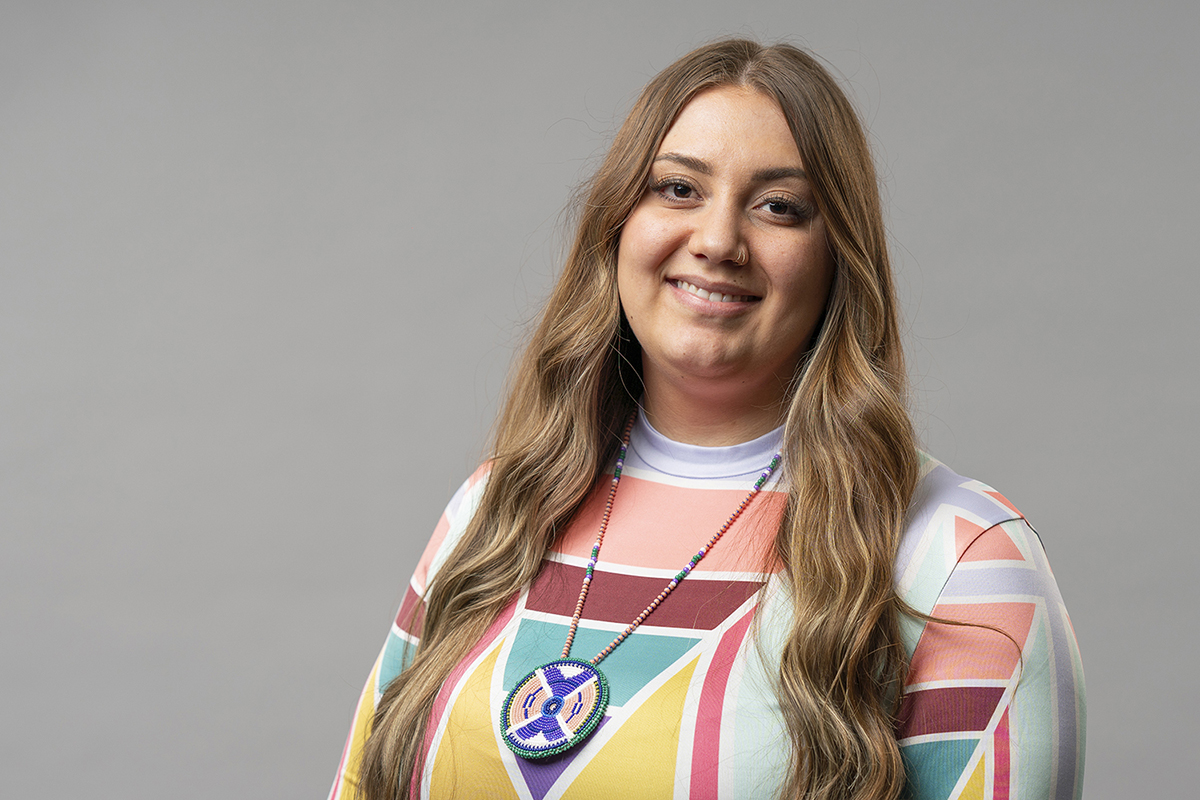
By Phil Stempin, UM News Service
MISSOULA – Less than a year after graduating from the University of Montana’s Alexander Blewett III School of Law, Ericka Camposan earned admission to practice in every tribal court in Montana.
It’s a rare professional achievement that many attorneys never complete.
Camposan said the law school’s Indian law curriculum, faculty connections and professional network gave her the foundation to serve tribal communities immediately after graduation. Her admission to each tribal court also expands access to legal help in rural communities where few attorneys are available to practice.
A 2025 UM graduate from Billings and an enrolled member of the Crow Tribe, Camposan completed five tribal bar examinations and the additional admission requirements for each court. She recently passed the Fort Peck Tribal Court bar exam, finishing a process that required extensive travel, persistence and knowledge of several legal systems. She is now able to practice law in each of the seven tribal nations in Montana.
She completed the admissions while beginning her career as a tribal law staff attorney with the Montana Legal Services Association.
“Doing it within a year is almost unheard of,” Camposan said. “It was a lot of work and a little bit of luck. I’m really glad to be done taking exams.”
The Montana Legal Services Association is the state’s only statewide civil legal aid organization. It assists eligible clients with family law, housing, public benefits, estate planning and other civil matters.
Camposan said access to legal services can be limited in tribal communities, particularly in rural areas. Relatively few attorneys are admitted to practice in every tribal court.
“The number of people barred in tribal courts is minimal,” Camposan said. “Many of the communities we serve are rural. Being admitted to those courts makes it easier to provide direct assistance.”
Because Camposan can practice in both Montana state court and tribal courts, she is uniquely positioned to help clients determine which jurisdiction may best address their legal needs.
Each court has its own rules, procedures and filing requirements. Family law, estate planning and other matters may be handled differently depending on the jurisdiction.
“All of their policies and procedures are different,” Camposan said. “That is one of the hardest parts of practicing in multiple jurisdictions. It is also what makes the work interesting.”
Her job requires her to understand each client’s circumstances and identify the best legal path.
“You look at the specific issue and the client’s best interests,” she said. “Then you help them in the best way possible.”
Camposan’s work includes legal advice, limited representation and larger cases. She also travels across Montana to meet with clients, court employees and community members.
Outreach is a major part of her job.
“The biggest thing is making connections and letting people know that Montana Legal Services exists,” she said. “Court staff are more willing to help when they know you and see you in the community.”
Those relationships also build trust with clients.
Camposan said her Montana roots and connections to tribal communities help clients feel more comfortable discussing difficult legal issues.
“It makes a difference when people know you and your family,” she said. “They may be more willing to open up.”
That trust is especially important in estate planning. Conversations about death can be taboo in some tribal communities, she said. Attorneys must approach those discussions with patience, respect and cultural understanding.
Camposan entered law school knowing she wanted to practice federal Indian and tribal law. She credits the Blewett School of Law’s Indian law curriculum with preparing her for the work.
“The information you learn in those classes sets you up for success,” she said. “The connections I made in law school have made a huge difference. It is a small and close-knit community, and you graduate with a built-in network.”
She said Professor Kekek Stark and other members of the law school community helped her understand the steps required to seek admission in each tribal jurisdiction. But passing the exams was only part of the challenge.
Camposan also had to identify each court’s requirements, complete applications, gather recommendation letters and coordinate exam dates. She took nearly all the exams in person.
“The administrative part is what people do not think about,” she said. “You have to be persistent. You keep calling, keep trying and sometimes show up at the door.”
Some opportunities came with little notice. Camposan only had about a week to prepare for the Blackfeet Tribal Court bar exam.
She completed the process while working full time and raising a daughter. She credits her husband and family for helping her manage the travel, studying and long hours.
At Montana Legal Services Association, Camposan supports efforts to expand access to justice. Those efforts include community outreach, lay advocacy training and a tribal advocate incubator project.
Some tribal courts allow trained nonlawyers to represent clients. Those advocates can help fill service gaps in communities with few available attorneys.
Camposan has taught training sessions for people preparing to practice in tribal courts. She sees the programs as another way to connect people with legal help.
Her growing visibility in tribal communities strengthens those efforts.
“The more outreach I do, the more people recognize me,” she said. “The best way to establish trust is to be present in the community.”
Camposan said earning admission to every tribal court is not the end goal. It is a tool that will help her build the career she envisioned before entering law school.
“This is what I went to law school to do,” she said. “I want to give back to my community, help people across Montana and provide direct services to tribal communities. This is work I plan to do for my entire career.”
###
Contact: Phil Stempin, director of events, marketing and communications, UM Alexander Blewett III School of Law, 406-243-6509, phil.stempin@umontana.edu.
